Coffee-to-Water Ratio: How Much Coffee Should You Use?
4 min read · Updated 2026-11-26
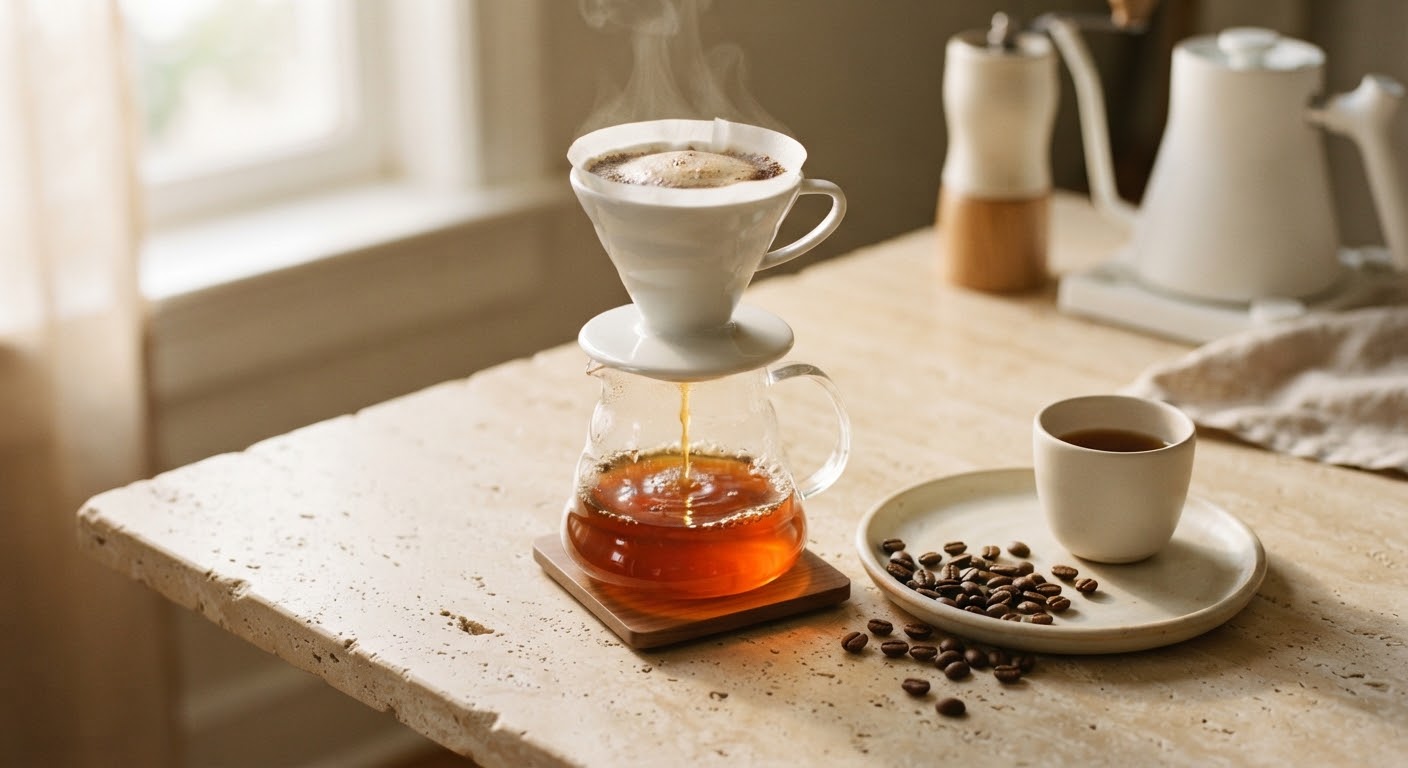
How brew ratio works, why it changes strength more than extraction, and how to pick a starting ratio for pour over, immersion, and espresso.
What a brew ratio means
A brew ratio expresses how much water you use for a given amount of coffee, usually written as coffee to water, such as 1:16. A 1:16 ratio means 1 gram of coffee for every 16 grams (or milliliters) of water, so 20 grams of coffee brewed with 320 grams of water. Ratios are almost always measured by weight rather than volume, because scoops are inconsistent: the same scoop can hold noticeably different amounts of coffee depending on the bean and the grind. A cheap digital scale removes that guesswork.
You will also see ratios written the other way around, as grams of coffee per liter of water. The Specialty Coffee Association uses 55 grams of coffee per kilogram of water as its test ratio for certified home brewers, which is the same thing as roughly 1:18.
Ratio controls strength; grind and time control extraction
It helps to separate two ideas that are easy to confuse. Strength is how much dissolved coffee is in your cup. Extraction is how much of the ground coffee actually dissolved into the water. Changing the ratio mostly changes strength: more water per gram of coffee gives you a weaker cup, and less water gives you a stronger one, assuming extraction stays similar.
Extraction is driven more by grind size, contact time, and temperature. This is why a common piece of advice - just use more coffee if your cup is weak - can mislead. If your coffee is weak but tastes sour and thin, the problem is usually under-extraction, not ratio. If it is weak and tastes fine but watery, adding coffee (lowering the ratio) is the right move. Understanding the difference is the core skill this guide is trying to build; our guide to coffee extraction goes deeper.
Starting points by brew method
Different methods have different conventions. For pour over, ratios around 1:15 to 1:17 are common recommendations; Food Network's pour over guide suggests 1:15 to 1:16 for that method, with 1:17 as a general standard. For immersion methods like French press, similar ranges around 1:15 work as a starting point. Espresso is expressed as a beverage ratio instead: the weight of the finished drink relative to the dry coffee, so a 1:2 espresso means 18 grams of ground coffee producing 36 grams of liquid.
Treat all of these as starting points, not rules. Roast level, grind, water, and personal taste all shift where a coffee brews best.
How to measure your ratio
Put your brewer on a scale, tare it, add your coffee dose, then pour water until the scale reads your target. For a 1:16 pour over with 20 grams of coffee, that is 320 grams of water in total, including the bloom. For immersion methods, add all the water at once and stir. For espresso, place the cup on a scale under the portafilter and stop the shot at your target beverage weight.
Writing your ratio down alongside grind and time is what turns random brewing into repeatable brewing. Our coffee calculator does the arithmetic for you if you would rather not do the math.
Adjusting ratio to taste
If a cup tastes balanced but too weak, use a little more coffee at the same grind and time. If it tastes balanced but too strong, use less coffee. Change one variable at a time, and move in small steps - a shift of about one ratio point, such as 1:16 to 1:17, is enough to notice.
Avoid using ratio to fix flavor problems it cannot fix. Sourness usually points to under-extraction, so reach for a finer grind or more time first. Bitterness and harshness usually point to over-extraction, so go coarser or shorter. Once extraction is roughly right, ratio becomes your strength dial.
Common questions
What is a good coffee-to-water ratio for beginners?expand_more
Start near 1:16 for pour over and French press - about 20 grams of coffee to 320 grams of water - and adjust from there.
Is a 1:15 ratio stronger than 1:17?expand_more
Yes. A smaller second number means less water per gram of coffee, so the brew is stronger.
Should I measure coffee by weight or volume?expand_more
By weight. Scoops vary with bean density and grind, while a gram is always a gram.
Does ratio change extraction?expand_more
Mostly it changes strength. Extraction is driven more by grind size, contact time, and temperature.
Put it into practice
From the database
Sources
- Towards a New Brewing Chart | 25, Issue 13open_in_new
Specialty Coffee Association · Industry Organization · Accessed 2026-11-26
- Extraction yield and TDSopen_in_new
Coffearium · Other · 2026-10-10 · Accessed 2026-11-26
- How to Make Pour Over Coffeeopen_in_new
Food Network · Other · 2024-02-06 · Accessed 2026-11-26
Last verified: 2026-11-26